skip to main |
skip to sidebar
 Trellis Maximus: The Hippodrome of Istanbul
LOST+ FOUND:
Radical Adaptive Re-use Strategies in Asian Mega-Cities
This blog covers research and speculation from the 2005 Rotch Scholarship year abroad. The focus was on radical forms of heritage and adaptive re-use in Asian mega-cities, specifically Istanbul, Mumbai, Bangkok and Tokyo. In each location distressed built artifacts were sought out and envisioned with interventions that adapted them to new forms of urbanity. The inquiry addresses six instances of history lost and found, from the vanishing Hippodrome of Istanbul to the contemporary ghost-skyscrapers of Bangkok. The result is a fresh look at the concept of architectural heritage in light of the pressures facing Asia's mega-cities. The chapters of the study are on the sidebar to the right. Courtyard Cricket: The Bollywood Cinemas of Bombay
Next stop: Introduction
-or- skip Intro: go straight to Istanbul.
Courtyard Cricket: The Bollywood Cinemas of Bombay
Next stop: Introduction
-or- skip Intro: go straight to Istanbul.
HARBOR WALLS
Contrary to Zeynep Celik’s claim that “the city lost its face on the Golden Horn” when the 1980’s municipal government performed some heavy handed urban renewal, it actually sloughed off an acquired layer of industry that was not present when the original defensive harbor walls were built. The chaotic and colorful collection of fishing shacks and storage buildings may have been lost, but the city walls were brought back to light. For several hundred years these walls were subsumed into the workmanlike fabric of the Fener neighborhood, becoming so much impediment and building material. Over the years, houses were built through them, chunks were knocked down for roads, and structures were perched over them. Walls that once repelled the Huns are today used to prop up living rooms.
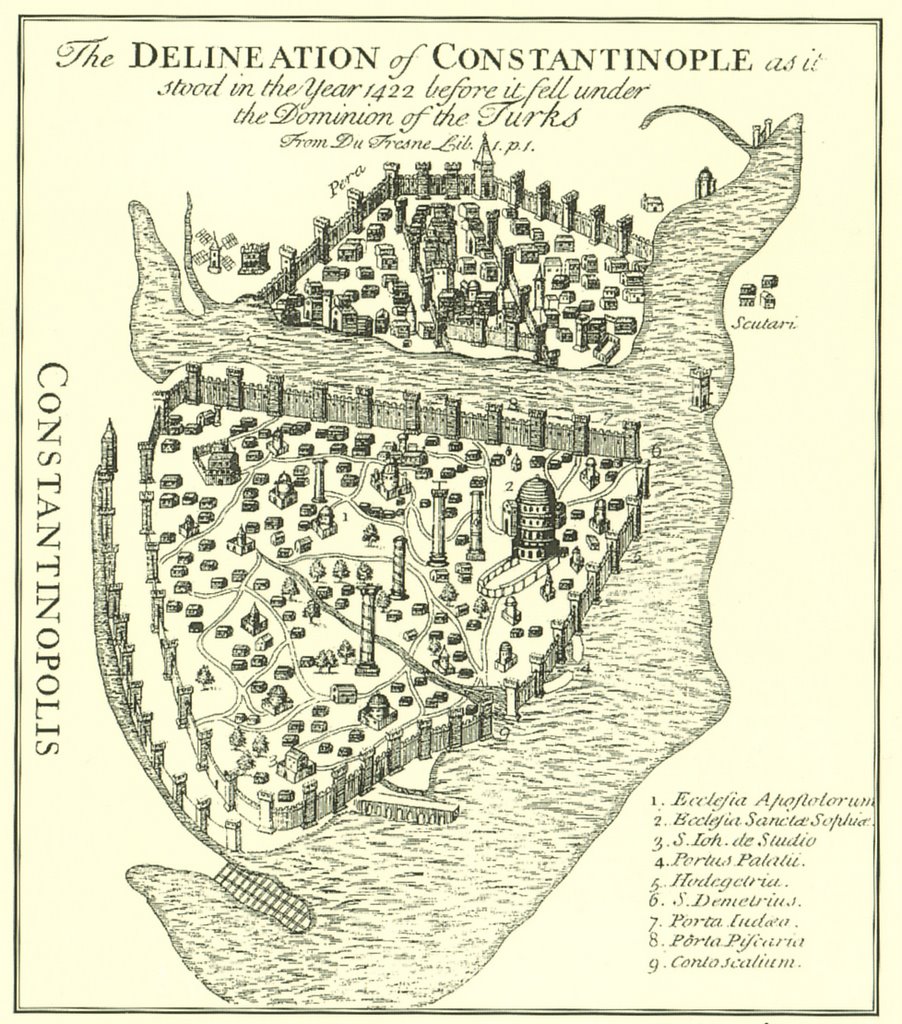
The original system of walls was built under the reign of Theodosius II to enclose an expanded Constantinople in 413. The harbor walls along the Golden Horn were the lowest and weakest in defense terms, with the bulk of the effort going to the western front that could be easily attacked by land. The Marmara Sea walls, that could be easily reached by boat, were somewhere in between. The Golden Horn had the noteworthy security of two towers that would stretch a chain across the inlet to prevent ships from entering.

The western walls, known today as the Theodosian Walls, are the most intact and easily viewed piece of the original system. There have been numerous archaeological studies and ongoing efforts to rebuild them have led to a patchwork of impressive monumental sections, though the veracity of these reconstructed sections is questionable. Swaths of grassy landscape make viewing these walls relatively easy and approachable. Since they stretch seven kilometers from the Golden Horn to the Marmara, a popular way to see them is via bus or car; a high speed motorway conveniently follows the walls, in places where the moat would have been. They are still one of the most scenic monuments in the city, with their picturesque air of decay conforming to the popular notion of Istanbul as a fading old man.
"I have seen the ruins of Athens, of Ephesus, and Delphi: I have traversed the great part of Turkey and many other parts of Europe, and some of Asia; but I never beheld a work of nature or art which yielded an impression like the prospect on each side from the Seven Towers to the end of the Golden Horn" (Lord Byron)
The Marmara walls are in decent shape, though exhibit more vernacular use than the western walls. Due to the steep topography of the city, many houses have been built up on the inner side and to varying degrees poke through or hang over into the mostly unused parkland below. Compared to the walls on the Golden Horn, the Marmara walls are mostly discernible as an object, and are noted in most guidebooks for viewing. However, for the purposes of this study, the eroded harbor walls along the Golden Horn in the Fener neighborhood are the most compelling.

The Golden Horn was considered one of the greatest natural harbors in the world. Coupled with the growth of the “new” city in Galata, the walls along the Gold Horn tell the story of the city’s desire to escape its imperial confines. Military tactics in the 19th century made city walls obsolete, and the fortifications along the Golden Horn were the first to be subsumed by more important economies facilitated by the harbor. Istanbul grew to the north, with the Golden Horn and the independently international mercantile city of Galata as the center of gravity in the 18th through the 20th centuries. The stronger the flow of traffic, the more the wall was eroded. Most of the urban landscape in Eminönü, near the busy Galata Bridge and ferry landings, is barren of the once vital harbor walls.

In this sense the entire wall system traces the pressure of urban flows. The southern and western walls were allowed to remain since the neighborhoods had no specific need to communicate through them, and regional arteries of traffic are aligned with historic trade routes through the original gates. Neighborhoods to the west remain some of the most conservative and isolated in spite of their proximity to the tourist friendly old city. The sea walls to the south haven’t had any pressure for access since the Theodosian Harbor silted up in the 8th century. The northern harbor walls, on the other hand, display the increasing pull of international trade to the north.

The harbor wall has lost its original use of keeping enemies out and now sits on land that is used for shops, garages, restaurants, and other uses related to newer economies. In many ways it is a nuisance, and is treated as such. Originally it had 12 well defended gates that could be closed in times of threat; today there are at least 24 roads that lead down to the waterfront, and numerous other ad hoc openings. Its original purpose as an impediment is now problematic considering the city’s rapprochement with the Golden Horn.
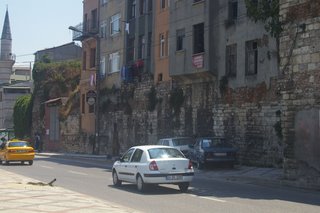
In the Fener neighborhood, the walls reach their palimpsest apex, where a constant siege is taking place by the denizens on the walls. The walls are eroded, punctured, mounted, patched up and otherwise occupied in the rough desire to improve individual surroundings. Many buildings today use the walls for structure, rendering the wall as an independent object null. It has become a hybrid of the city, co-opted into the fabric in many small stages. In most cases it is reduced to 3-4 meters tall. A generous rough estimate would place the amount of wall remaining at 20% or less along the Golden Horn. That would mean that somewhere around 130,000 cubic meters is missing, enough to fill the Hagia Sophia. Sometimes a nice café will strategically re-build the wall in order to highlight its venerable location, but the bricks and mortar are clearly new. Other times the wall is a highly utilitarian enclosure, and concrete will be used to fill in the missing bits. Most often, though, it is in the way, and windows and doors are carved out of something meant to repel cannonballs.
Next stop: Hippodrome
CITY OF LAYERS
Like several times in its past, Istanbul has exploded in population and income to become a truly global city. Today the population stands at around 11 million, one of the largest cities in Europe or Asia, and is Turkey’s foremost economic domain. Agricultural policies in the post war era, as well as a long simmering war with the Kurdish population has led to a dramatic immigration from the rural lands. The quirky Turkish law that allows any structure built overnight to remain led to a black market economy of gecekondu, literally overnight housing, for this migrant population. As much as 60% of the city may have originally been built this way. This newly relocated and underemployed population provides for the highly energetic service economy. Even small cafes and shops have half a dozen staff catering to you. This remarkable level of service both enhances and defines the tourist experience; the competition to hook a sale leads to the gauntlet of “hey mister” cries that can tire out even the sturdiest of visitors.

Its location between Europe and Asia makes Istanbul an intriguing destination for each continent to get an accessible taste of the other. Flights from both Frankfurt and Cairo routinely run $100 and take only 2 hours. Its proximity and allure to different cultural spheres has made it one of Europe and Asia’s fastest growing tourist destinations. However, this liminal position means that it is also subject to greater vicissitudes of visitors during good and bad times. This year tourism from the west is down due to the combined news of the bird flu, renewed terrorism by the Kurdish PKK, and war in the Middle East. Tourism from the east remains strong and likely will continue to grow with the recent reawakening of Islamic pride in Turkey; seeing the Sultan Ahmet Mosque during Friday prayer is an awesome sight because of the numbers of religious tourists in collective prayer.
In addition to being a gateway to the “other,” Istanbul is also claimed by multiple cultures; depending on whom you ask, Constantinople either “fell” or was “conquered” in 1453. Greeks, Romans, Christians, Moslems, Turks, Hittites, and Mongols have in time ruled. This piling on of conquest has resulted in a city uniquely endowed with cultural heritage. As a world center of commerce and empire for 2500 years, Istanbul simply cannot dig without unearthing its past: this year, when excavating for a railway tunnel under the Bosporus, construction workers discovered a rare intact 4th century port. It is true that relics continue to disappear at an alarming rate, but it is difficult to persuade the general public of the danger. The city is the equivalent of a rain forest of antiquities.

The extent of the tourist city is neatly indicated by the Plan Tours bus route. For only €20 one can get a grip on the city in 58 bite sized chunks. Not included on the tour is the new middle class city. Skyscrapers are kept at a healthy distance from the old city after some unfortunate examples were built in nearby Beşiktaş and Taksim; the wildly popular Kanyon Mall in Levent by Jerde Partnership, connected by a quiet and clean metro has security check-in; Kemer Country, designed in part by Andreas Duany, is a suburb that blends Ottoman stylings on an American suburban superstructure:
"These are modern homes, each one carefully designed to blend in not only with their lovingly landscaped setting but with a tradition of architecture and the inspiration of the great Turkish architect Mimar Sinan, whose awesome aqueducts rise up in the distance. This is Istanbul? As seen from Kemer Country." (From KemerCountry.com)
 Kanyon Mall by Jerde Partnership
The old city is kept free of these new symbols of growth, and in fact might be regressing to an earlier form as the city government pushes forward with plans to rebuild several streets in their best approximation of the Ottoman style. This is clearly the acceptable historic era, exhibiting the once great Turkish empire while also satisfying the contemporary traveling public’s desire for a sensory experience with the past. What better way to really see Istanbul/Constantinople than to wander the “same” streets that beguiled Pierre Loti? After all, when you’ve come this far, you don’t want to see concrete government buildings. This is the heart of cultural tourism: not to see the re-creations (we go to Miniatürk for that), but to be among the aura of the original. Thus, the skyscrapers and growing middle class of new Turkey are banished to the outskirts like the North African banlieus of Paris. They are neither seen nor heard and the old city can go back to being its timeless self.

This study will focus on two remnants of the fallen city, artifacts that once demonstrated greatness, but now get in the way. As such they have been pulled into the fabric of the city by both municipal projects and individuals. First, the old city walls, as in so many contemporary cities, are obsolete. They are also ugly; while many remark on their impressive scale, few will wax on their aesthetic value. Because of their original use of providing safety, they are at odds with contemporary needs for free flowing communication. This combination makes them an interesting tool with which to read the growth of the city. Second, the former Hippodrome is today conspicuously absent from the scene. It is often remarked upon in tourist guides and occupies an almost mythical role in the history of the city, but is represented by three decaying monuments and a strangely anonymous 40 meter wall.
Next stop: Harbor Walls