skip to main |
skip to sidebar
 Trellis Maximus: The Hippodrome of Istanbul
LOST+ FOUND:
Radical Adaptive Re-use Strategies in Asian Mega-Cities
This blog covers research and speculation from the 2005 Rotch Scholarship year abroad. The focus was on radical forms of heritage and adaptive re-use in Asian mega-cities, specifically Istanbul, Mumbai, Bangkok and Tokyo. In each location distressed built artifacts were sought out and envisioned with interventions that adapted them to new forms of urbanity. The inquiry addresses six instances of history lost and found, from the vanishing Hippodrome of Istanbul to the contemporary ghost-skyscrapers of Bangkok. The result is a fresh look at the concept of architectural heritage in light of the pressures facing Asia's mega-cities. The chapters of the study are on the sidebar to the right. Courtyard Cricket: The Bollywood Cinemas of Bombay
Next stop: Introduction
-or- skip Intro: go straight to Istanbul.
Courtyard Cricket: The Bollywood Cinemas of Bombay
Next stop: Introduction
-or- skip Intro: go straight to Istanbul.
HARBOR WALL: SITE
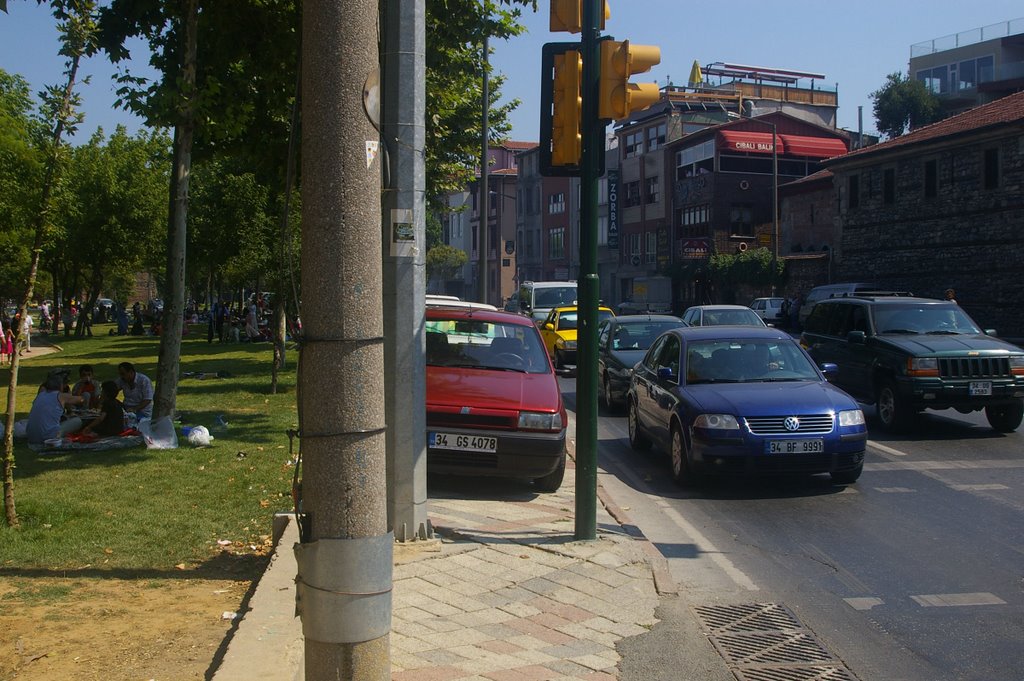
The urban renewal in the 1980’s that exposed the harbor wall also created a park where there once was a crowded fishing and maritime industry. Preservationists decried this sterilization for tearing down more than a few treasures that stood in the way, although there are a handful of historic structures trapped in peculiar traffic islands. Over the past 20 years there has been an admirable effort to clean the Golden Horn, so that today it is common to see people swimming and fishing in it. It no longer has the stench of pollution, and is seen again as an amenity, this time for recreation instead of industry. It is a common story around the world, and as the water again gains in popularity, so does the park. People arrive early on the weekends to stake a claim, and those who arrive later are relegated to the zone by the street. The waterfront and roadfront are two different worlds, though due to the demand, both are filled.
The park is heavily used by families picnicking, but the traffic is bad. It is dirty and noisy, and creates a modern wall of noise and danger that separates the neighborhood from the waterfront and impinges upon their recreation. Often illegally parked cars provide the only filter between the activities and the high speed roadway. The noise is intense and the grilled food acquires the unfortunate flavor of road pollution. Today’s marauding hordes are buses and taxis.
HARBOR WALL: THE RECYCLED CITY
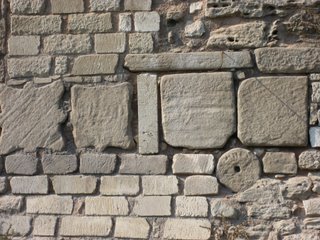
The old city walls present an alternative, possibly heterodox, version of preservation. It is often stated that Istanbul is a city of layers, but more precisely, it is a city of layered conquest. There have been many distinct masters of the city, and each time the city was reborn in the image of the conqueror. Byzas.…Constantine…Justinian…Theodosius…Mehmet…Ataturk…Dalan…Topbaş…at each transition, the contested city became an urban canvas on which the projections of the new authority were writ. The Byzantine Milion (the Golden Milestone) was disassembled to construct a nearby water tower. The Roman Basilica Cistern is supported by 336 columns taken from the extent of the empire; Süleyman took the top tier from the hippodrome and used it in part to support his mosque complex.
No where is this recycling more evident than in the city walls. Looking closely at the walls you will see column pieces, entablature, gravestones, steps and other miscellany of the past. It is a masonry soup of losers; civilizations consigned not to the trash heap of history, but the recycling bin. There was also a practical reason for the layering of disparate materials: the diverse material properties would react to earthquakes differently and make the wall less likely to fail catastrophically. Great works that once indicated wealth and power in turn made ample filler. The first line of defense was comprised of the cultural oeuvre of the previous empire.
HARBOR WALL: THEODOSIUS JUMPS

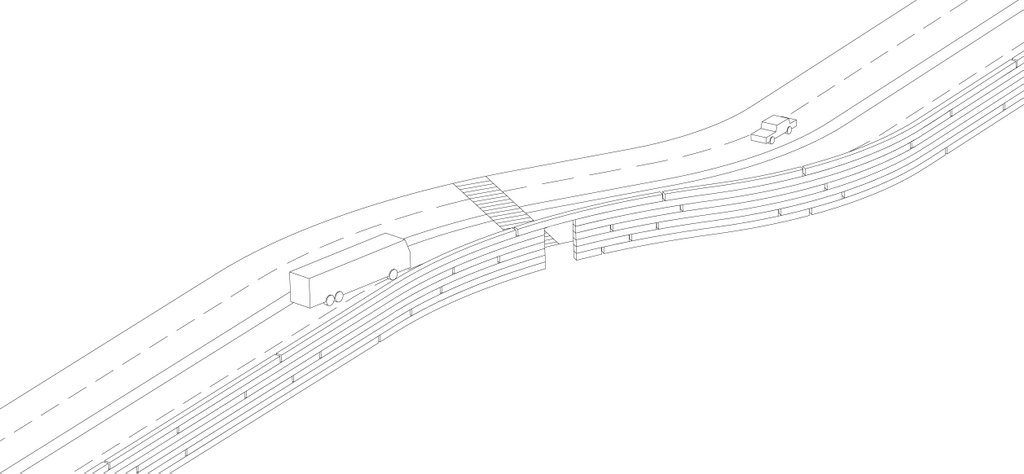
I propose a recycled and repositioned harbor wall, fortifying the park against the proximate undesirable vehicles. But more than a wall, it would be a repository for all the fast diminishing cultural artifacts in the city. Over time it would increase at the pace of the renewal of the city. As historic structures are disassembled, they would be added to the new wall in discreet segments approximately half a meter high. Each segment would represent one “lost” project recycled back into a new use. The segments would march along the park where they are needed, and leapfrog over defined thresholds and areas where the park is not used for recreation. After the approximately two kilometers of park is lined, a second layer would begin snaking back to the beginning. Instead of the current condition of tertiary heritage being simply thrown out or lost as aggregate in new projects, the new park wall would be a zone of collection and growth. Thus the wall would mature, acting as a barometer of urban renewal. The taller the wall, the more things lost, the more progress gained.
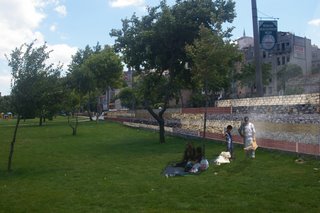
At the same time, recreation in the park would be protected from the traffic on Abdülezel Paşa Avenue on the other side of the wall. At first it would simply act as a line of definition, but in time would grow above the height of cars and tour buses. Grilled meat wouldn’t taste like exhaust anymore. Children would kick balls against the wall, perhaps hitting a Byzantine relief. People would lean against Roman bricks and columns. Thresholds in the wall would accommodate sidewalks and the few building uses, and in places where the park is too thin to be usable, the wall would disappear, giving the drivers a periodic view of the Golden Horn. Because each segment would be a discrete demolition project, the final wall would be a sort of calico of competing works, all laid to rest in the same format. Between segments, a small space would allow the projects to “breathe” and give glimpses of the other side.
Next stope: Trellis Maximus
HARBOR WALLS
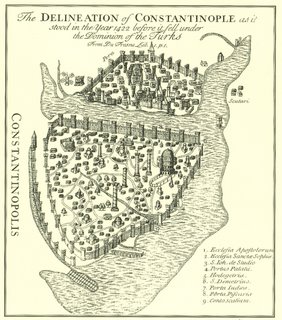
Contrary to Zeynep Celik’s claim that “the city lost its face on the Golden Horn” when the 1980’s municipal government performed some heavy handed urban renewal, it actually sloughed off an acquired layer of industry that was not present when the original defensive harbor walls were built. The chaotic and colorful collection of fishing shacks and storage buildings may have been lost, but the city walls were brought back to light. For several hundred years these walls were subsumed into the workmanlike fabric of the Fener neighborhood, becoming so much impediment and building material. Over the years, houses were built through them, chunks were knocked down for roads, and structures were perched over them. Walls that once repelled the Huns are today used to prop up living rooms.
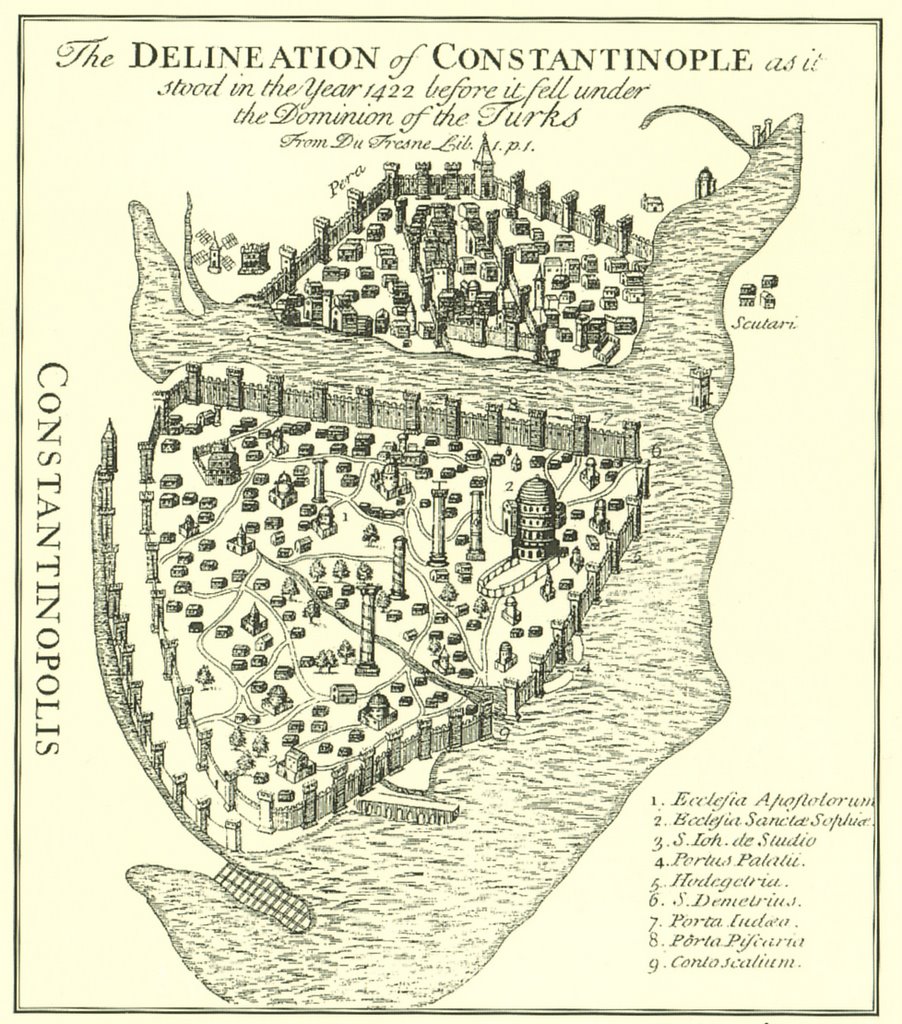
The original system of walls was built under the reign of Theodosius II to enclose an expanded Constantinople in 413. The harbor walls along the Golden Horn were the lowest and weakest in defense terms, with the bulk of the effort going to the western front that could be easily attacked by land. The Marmara Sea walls, that could be easily reached by boat, were somewhere in between. The Golden Horn had the noteworthy security of two towers that would stretch a chain across the inlet to prevent ships from entering.

The western walls, known today as the Theodosian Walls, are the most intact and easily viewed piece of the original system. There have been numerous archaeological studies and ongoing efforts to rebuild them have led to a patchwork of impressive monumental sections, though the veracity of these reconstructed sections is questionable. Swaths of grassy landscape make viewing these walls relatively easy and approachable. Since they stretch seven kilometers from the Golden Horn to the Marmara, a popular way to see them is via bus or car; a high speed motorway conveniently follows the walls, in places where the moat would have been. They are still one of the most scenic monuments in the city, with their picturesque air of decay conforming to the popular notion of Istanbul as a fading old man.
"I have seen the ruins of Athens, of Ephesus, and Delphi: I have traversed the great part of Turkey and many other parts of Europe, and some of Asia; but I never beheld a work of nature or art which yielded an impression like the prospect on each side from the Seven Towers to the end of the Golden Horn" (Lord Byron)
The Marmara walls are in decent shape, though exhibit more vernacular use than the western walls. Due to the steep topography of the city, many houses have been built up on the inner side and to varying degrees poke through or hang over into the mostly unused parkland below. Compared to the walls on the Golden Horn, the Marmara walls are mostly discernible as an object, and are noted in most guidebooks for viewing. However, for the purposes of this study, the eroded harbor walls along the Golden Horn in the Fener neighborhood are the most compelling.

The Golden Horn was considered one of the greatest natural harbors in the world. Coupled with the growth of the “new” city in Galata, the walls along the Gold Horn tell the story of the city’s desire to escape its imperial confines. Military tactics in the 19th century made city walls obsolete, and the fortifications along the Golden Horn were the first to be subsumed by more important economies facilitated by the harbor. Istanbul grew to the north, with the Golden Horn and the independently international mercantile city of Galata as the center of gravity in the 18th through the 20th centuries. The stronger the flow of traffic, the more the wall was eroded. Most of the urban landscape in Eminönü, near the busy Galata Bridge and ferry landings, is barren of the once vital harbor walls.

In this sense the entire wall system traces the pressure of urban flows. The southern and western walls were allowed to remain since the neighborhoods had no specific need to communicate through them, and regional arteries of traffic are aligned with historic trade routes through the original gates. Neighborhoods to the west remain some of the most conservative and isolated in spite of their proximity to the tourist friendly old city. The sea walls to the south haven’t had any pressure for access since the Theodosian Harbor silted up in the 8th century. The northern harbor walls, on the other hand, display the increasing pull of international trade to the north.

The harbor wall has lost its original use of keeping enemies out and now sits on land that is used for shops, garages, restaurants, and other uses related to newer economies. In many ways it is a nuisance, and is treated as such. Originally it had 12 well defended gates that could be closed in times of threat; today there are at least 24 roads that lead down to the waterfront, and numerous other ad hoc openings. Its original purpose as an impediment is now problematic considering the city’s rapprochement with the Golden Horn.
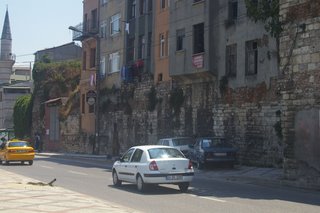
In the Fener neighborhood, the walls reach their palimpsest apex, where a constant siege is taking place by the denizens on the walls. The walls are eroded, punctured, mounted, patched up and otherwise occupied in the rough desire to improve individual surroundings. Many buildings today use the walls for structure, rendering the wall as an independent object null. It has become a hybrid of the city, co-opted into the fabric in many small stages. In most cases it is reduced to 3-4 meters tall. A generous rough estimate would place the amount of wall remaining at 20% or less along the Golden Horn. That would mean that somewhere around 130,000 cubic meters is missing, enough to fill the Hagia Sophia. Sometimes a nice café will strategically re-build the wall in order to highlight its venerable location, but the bricks and mortar are clearly new. Other times the wall is a highly utilitarian enclosure, and concrete will be used to fill in the missing bits. Most often, though, it is in the way, and windows and doors are carved out of something meant to repel cannonballs.
Next stop: Hippodrome